
Enterprise AI Weekly #2
AI agents explained, a fresh perspective on AI and sustainability, how MCP is unlocking capabilities for LLMs, how to use AI for deep research and why you should be polite to your LLM.


Welcome to Enterprise AI Weekly #2
Welcome to the Enterprise AI Weekly Substack, published by me, Paul O'Brien, Group Chief AI Officer and Global Solutions CTO at Davies.
Enterprise AI Weekly is a short-ish, accessible read, covering AI topics relevant to business of all sizes. It aims to be an AI explainer, a route into goings-on in AI in the world at large, and a way to understand the potential impacts of those developments on your business.
If you’re reading this for the first time, you can read previous posts at the Enterprise AI Weekly Substack page.

Explainer: What is Agentic AI?
Agentic AI is gaining a huge amount of traction currently, particularly when it comes to application in business. Our investors are excited about its potential for Davies, as are we. So, what is it?
Agentic AI typically refers to advanced AI systems capable of autonomous decision-making and action-taking to achieve specific goals. These AI agents can interpret complex contexts, adapt to changing environments, and execute multi-step tasks with minimal human intervention. Unlike traditional systems that follow predefined rules, agentic AI employs sophisticated technologies such as machine learning, natural language processing, and large language models to analyse data, make informed decisions, and continuously learn from interactions.
The key features of agentic AI include its ability to reason, plan, and solve problems independently, often operating through multiple specialised AI agents working together. These systems can handle complex workflows, optimise processes, and collaborate with humans (‘human in the loop’) as required. Agentic AI's adaptability and autonomous nature make it particularly valuable for tasks that require real-time decision-making and responsiveness to dynamic situations.
The way I prefer to explain agentic AI is to describe the way that Davies handles a claim today as a human implementation of exactly this. The end-to-end claims process is broken down into its component parts, with different processes from FNOL to resolution being handled by different people in the business. We do things on our own, but we also work with colleagues when necessary. We look to continually improve the process to achieve the best outcomes for our clients. Agentic AI takes the same approach but automates parts of the process where appropriate and doubles down on humans where they are key.

1. AI is not necessarily bad, focus on the bigger picture.
Gillie Fairbrother (Davies’ Global Responsible Business Officer) and I have spoken a fair bit recently about sustainability and AI. It’s something of a hot topic in the trade press, and as Davies is a responsible business, we have worked to ensure we understand our position and that we are balancing delivering the right outcomes for the business with looking after our planet.
The environmental impact of AI is hotly debated online, particularly with respect to the energy and water consumption of large language models like ChatGPT. An excellent article by Andy Masley offers a refreshing perspective, arguing that focusing solely on individual AI usage is a misguided approach that distracts from more significant climate action. He highlights that while LLMs do consume resources, their impact is often overblown and pales in comparison to other common online activities and industries. Here’s a couple of examples from the article…
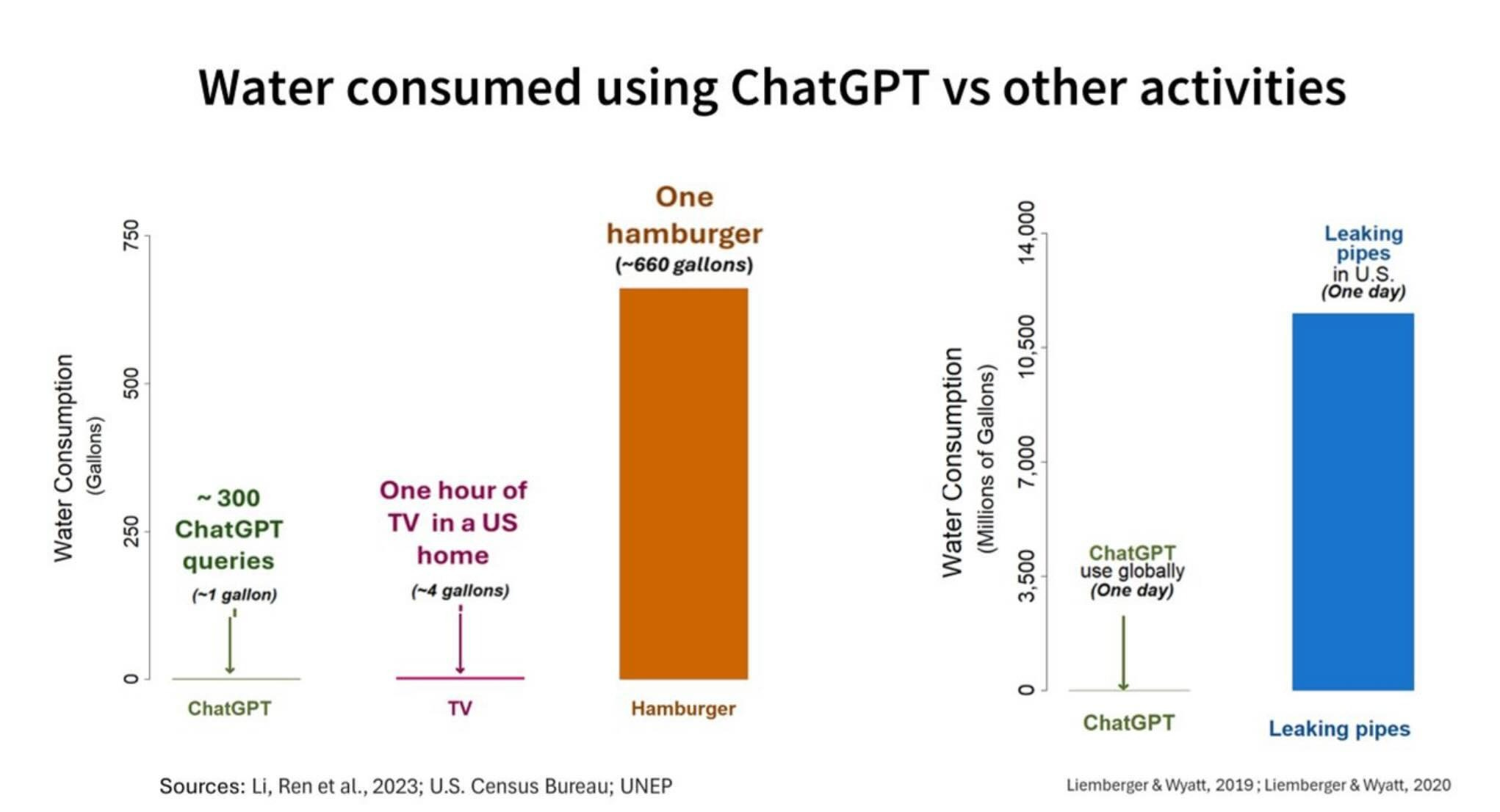

The core argument is that the climate movement shouldn't get bogged down in questions like whether individuals use ChatGPT, but instead focus on systemic changes and larger-scale emissions sources. He provides compelling comparisons, illustrating that activities like video streaming consume far more energy and water than individual AI queries. He also points out that the one-time energy cost of training large AI models, while significant, is amortised over billions of uses and enables powerful tools with various beneficial applications.
The article advocates for a more nuanced understanding of AI's environmental footprint, urging readers to avoid knee-jerk reactions and instead prioritise efforts that will have a more substantial impact on the climate. I highly recommend giving it a read.
Does this mean that we shouldn’t really worry about AI and the environment? Not at all. We should still optimise our AI use (for example by right sizing our language models), but it’s useful to understand that we’re not destroying the planet by implementing AI. I strongly suspect that when we look at the processes AI will replace, we may well end up net positive on our impact anyway.

2. MCP is powering up LLMs.
There’s a technology that you’ve likely never heard of powering up the capabilities of AI agents.
The Model Context Protocol (MCP) is revolutionising how AI systems interact with external data sources and tools. Introduced by Anthropic in late 2024 but now appearing in a wide range of solutions, MCP serves as a universal bridge between Large Language Models and various data repositories, business tools, and development environments. This open standard enables seamless, secure two-way connections, allowing AI assistants to access and utilise contextual information more efficiently without the need for custom integrations for each data source.
MCP's impact on business AI applications, particularly in the realm of agentic AI, is likely to be profound. It paves the way for more intelligent and autonomous AI agents that can understand context, make decisions, and execute tasks across multiple tools within an organisation's tech stack. This shift from passive AI tools to active, context-aware agents promises to transform workflows and boost productivity.
It will be important for us to understand the impact of MCP on the agentic AI solutions that we are creating within our business. It will power up our development tools, smooth the process of integration between platforms in our organisation, allow us to create reusable connectors between parts of the business and will be revolutionary for the potential capabilities of our agents.

3. You can Deep Research now, for free.
Deep research tools are AI-powered systems designed to conduct comprehensive, multi-step research tasks across the internet, synthesising information from various sources into coherent reports. These tools work by autonomously browsing the web, analysing diverse data types, and using advanced reasoning to compile findings into well-documented reports with clear citations. They’re AI agents, effectively!
The trailblazer in this space, OpenAI's Deep Research, is now available to ChatGPT Plus users, and can accomplish in minutes what would take a human analyst many hours. It’s still a paid offering however, and now it has free competitors.
Perplexity AI is another excellent tool that provides a range of advanced models including DeepSeek R1, and is explicitly trying to democratise Deep Research, no doubt driving the move by OpenAI to relocate their tool from their expensive Pro tier to the much cheaper Plus level.
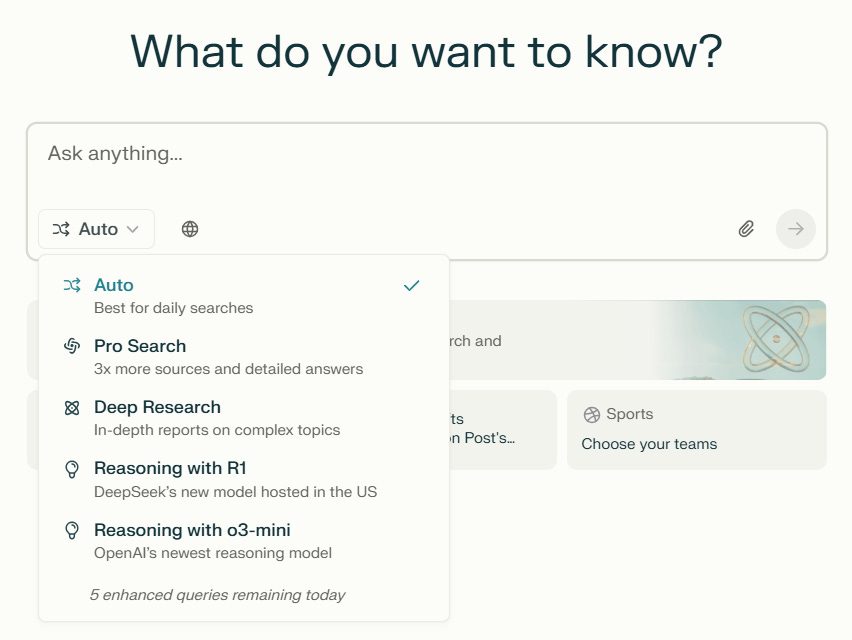
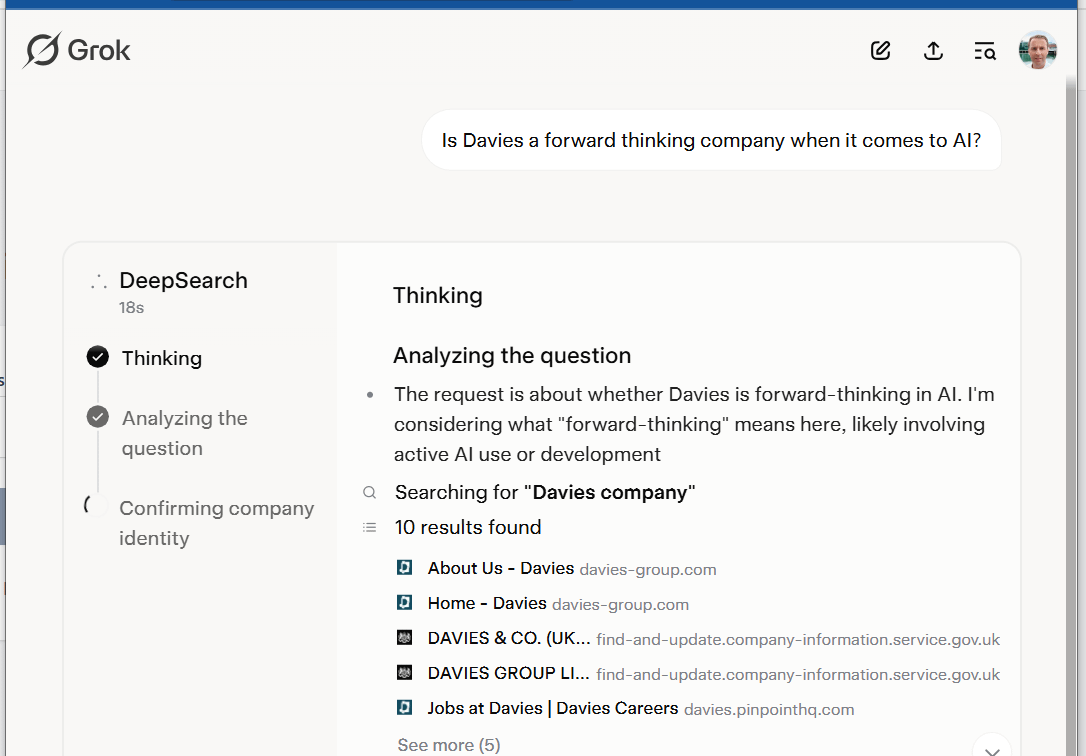
xAI's Grok 3, as discussed last week, also introduces DeepSearch in the free tier, a feature that scans the internet and uniquely latest X posts to analyse information and deliver abstracts in response to queries. This tool is part of xAI's push into the enterprise market, offering advanced reasoning capabilities and real-time data analysis. As with many of the ‘thinking’ models, it’s interesting to see the chain of thought (see last week’s post) leading to the resulting output. PS, Grok says ‘It seems likely that Davies is forward-thinking in AI’. 😀
These tools are useful, and it’s interesting to compare results between the services, but remember that you shouldn't upload private business data to unapproved tools. I am expecting similar functionality to arrive in Microsoft CoPilot in the future, and I’ll let you know here when it does. It’s already available in the consumer product via ‘Think Deeper’.

4. Do you talk politely to AI tools?
I want to share some fascinating research that touches on an unusual aspect of how we interact with AI: politeness. A recent paper, "Should We Respect LLMs? A Cross-Lingual Study on the Influence of Prompt Politeness on LLM Performance," explores how the way we phrase our requests to Large Language Models (LLMs) can significantly impact the quality and nature of their responses. The study, conducted across English, Chinese, and Japanese languages, reveals that impolite or rude prompts often lead to poorer performance, increased bias, and even refusals to answer. Interestingly, the "ideal" level of politeness varies depending on the language and cultural context, suggesting that LLMs are picking up on subtle nuances in human communication.
So, what does this mean for us in the business world? As we increasingly rely on LLMs for tasks ranging from customer service to content creation, it highlights the importance of mindful prompt engineering. We need to be aware that the tone and style of our prompts can influence the output and ensure that we are getting the best, most accurate, and unbiased results. Moreover, this research underscores the need for cross-cultural awareness in AI development and deployment, especially as we expand into global markets.

5. Some interesting insights on AI pricing.
Last week we talked about the capability and cost curves relating to AI (remember my Copilot created diagram?), and how this was challenging the prevailing wisdom about how AI endeavours would be expensive to run. This week, I’m backing this up with some hard data.
Since its initial release in March 2023, OpenAI's GPT-4 has seen significant price reductions, driven by increasing competition in the LLM market. The original GPT-4 was priced at $60 per million output tokens and $30 per million input tokens. By November 2023, GPT-4 Turbo was introduced at $30 per million output tokens and $10 per million input tokens. The trend continued with the launch of GPT-4o, initially priced at $15 per million output tokens and $5 per million input tokens, and later reduced to $10 per million output tokens and $3 per million input tokens by August 2024. In July 2024, OpenAI also introduced GPT-4o Mini, a budget-friendly option priced at $0.600 per million output tokens and $0.15 per million input tokens.
These price cuts reflect an 83% decrease in output token costs and a 90% decrease in input token costs over 16 months, while continuing to power up capability. OpenAI also offers a Batch API, providing a 50% cost reduction for asynchronous requests, priced at $1.875 per million input tokens and $7.500 per million output tokens.
Is this just an OpenAI thing? Absolutely not. This competitive pricing extends across the industry, with similar reductions from Google's Gemini models for example (couple with vastly enhanced capability), enhancing the accessibility of advanced AI for various use cases. Combine this with the ground-breaking advancements in efficiency from players such as DeepSeek, and I am confident we will see this trend continue.
Perhaps we are approaching a world where the raw cost of the AI capability is barely a consideration in the design of our systems, and the other costs (development, maintenance etc.) are where we need to focus.

POB’s closing thought(s)
By request, I have created a Teams channel to discuss topics mentioned in this post, and AI in general, with your fellow readers, and of course me too. To join, use this link.
I’m finishing this week’s post up with a podcast recommendation submitted by Jason Wolfe (thanks Jason, PS, Happy Birthday!). In the latest episode of Re:Thinking, respected author and organisational psychologist Adam Grant talks to Sam Altman on the future of AI and humanity. Sam and Adam discuss their hopes for technology that enhances human progress while maintaining human values, strategies for adapting to a changing world, AI’s ethical challenges and the role of human oversight, plus Sam discusses fascinating research on AI generated empathy vs human empathy, and the results are not necessarily what you expect (and definitely relevant to how we potentially serve our customers in the future).
I am off on Annual Leave for a few days, but see you next week (or in the Teams chat). 👍
Disclaimer: The views and opinions expressed in this post are my own and do not necessarily reflect those of my employer.